
Wind Energy and the Isle of Man
The Isle of Man has huge potential for clean, plentiful and secure renewable energy – to power a Manx economy where people and planet thrive.
Yet, today we spend more than £120 million a year importing expensive gas, oil and coal in volatile global markets.
Meanwhile, our own abundant resources (like wind, solar, tides and waves) remain untapped.
The right mix of onshore and offshore wind turbines could unlock a stronger energy system, and help tackle climate breakdown, at the pace we urgently need.
Mooir Vannin – let’s make it a wind-win
Right now, attention is focused on the Mooir Vannin offshore wind project, developed by Ørsted.
This page explains:
what’s being proposed
benefits and challenges
how to voice your support and demands, before it’s too late
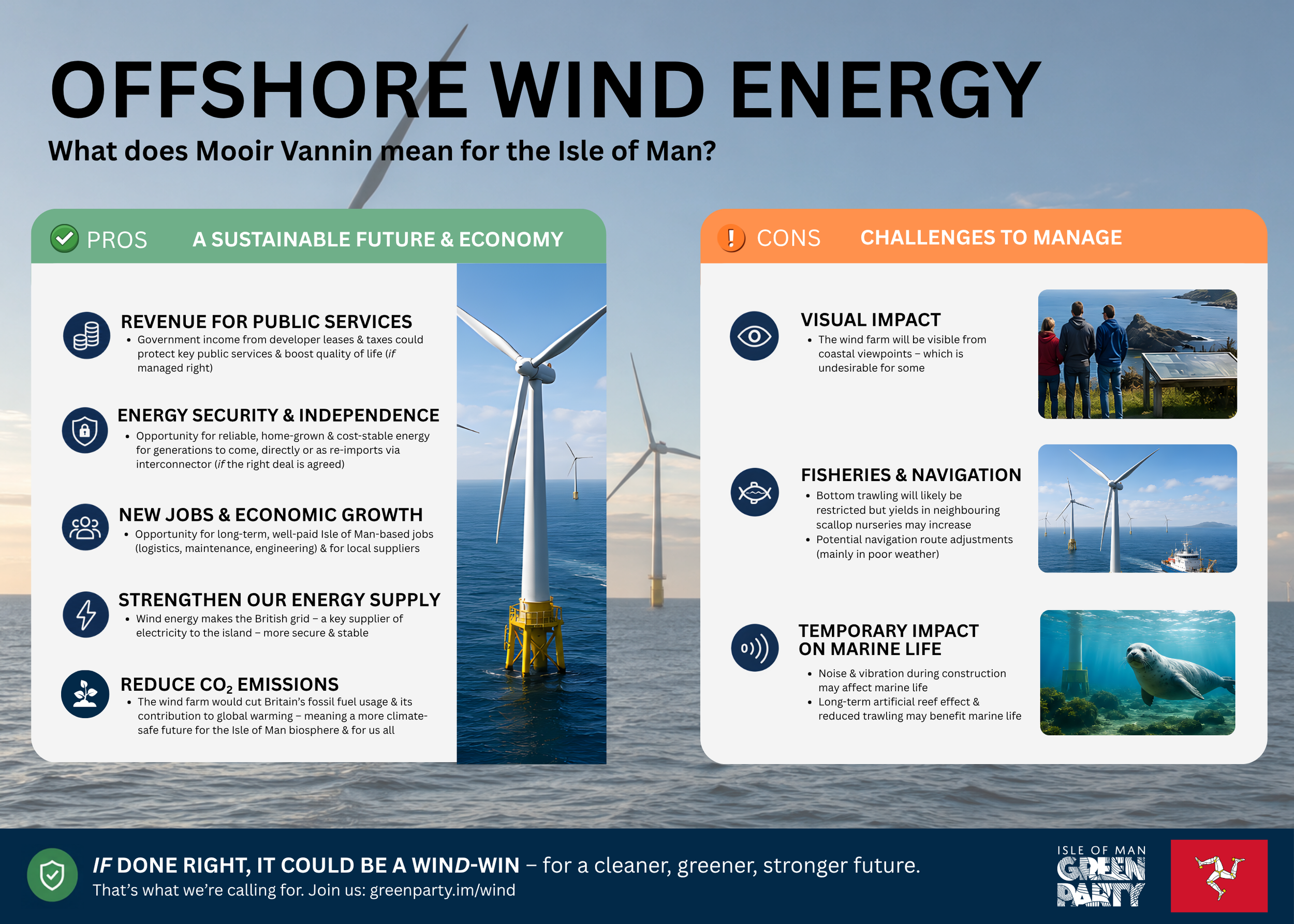
Summary of the pros and cons of the Mooir Vannin project
What is it?
The Mooir Vannin Offshore Wind Farm would be located within the Isle of Man’s territorial seas, approximately 6-12 nautical miles off the island’s east coast.
It would include around 87 wind turbines, with a capacity of roughly 1.4 GW – about the same as 10 Pulrose power stations.
The project is currently at the Examination stage. This means the independent examining body is conducting in-depth public hearings regarding the proposal's impacts. The examination must be completed by 9th September 2026, after which the examining body will have 60 days to submit a recommendation report to the Council of Ministers.
Why our wind?
The Irish Sea has some of the highest offshore wind capacity factors in the world.
That’s why this is an excellent location to generate clean renewable energy to displace fossil fuel use and drive global emissions reductions. The wind farm would reduce the UK’s future contributions to global warming (and ideally the Isle of Man’s; see discussion of direct grid connection below), meaning a more climate-safe future for the Isle of Man biosphere, and for us all.
How will the project benefit the Isle of Man?
Economic benefits
Alongside combatting the climate crisis, there is a strong economic case behind the Mooir Vannin project, with an estimated £2 billion of financial benefits for the Isle of Man during its 35-year operational lifetime, which could be vitally important for funding core public services such as Manx Care, as the island faces declining income from economic sectors including e-gaming.
The project will create long-term, well-paid Isle of Man-based jobs (logistics, maintenance, engineering) and opportunities for local suppliers.
In addition, Ørsted will establish a Community Investment Fund, providing up to £1.5m per year for the first 15 years (£22.5m total) for community projects and organisations across the island.
Energy security and independence
The island is almost entirely dependent on imported fossil fuels and Mooir Vannin is an opportunity for reliable, home-grown and cost-stable energy for generations to come, whether the electricity is brought onshore directly (there is an option to do so, which the government and Manx Utilities is considering) or re-imported via the interconnector.
The financial and energy security arrangements are still to be agreed. Mooir Vannin represents a once-in-a-generation opportunity for the Isle of Man — and we are calling on the government to negotiate hard to ensure the island captures the full benefit.
What about the criticisms and challenges?
Visual impact
Critics of the project have highlighted the visual impact of the turbines. At 6-12 miles offshore, Mooir Vannin will be visible from coastal viewpoints. For some, turbines on the horizon are an unwelcome intrusion on a view they'd rather see preserved. For others, they're beautiful symbols of a future-proof whole-nation UNESCO biosphere that has chosen to work in harmony with its environment for the long term. All energy has a visual footprint — oil and gas infrastructure simply puts it somewhere else.
Some have concerns that property values will be affected, however peer-reviewed studies of offshore wind farms in Denmark and Rhode Island found no statistically significant adverse effect on nearby or view-affected property values. Similarly, while some fear that tourism may be reduced, comparable research in coastal and scenic visitor destinations has generally found little evidence of significant adverse effects on tourism. A study of Block Island, where tourism is the largest revenue generator, found no negative impact on tourist trip numbers after the first U.S. offshore wind farm was built, and UK evidence reviews have found offshore wind impacts on tourism to be generally benign and sometimes positive.
Fisheries and navigation
The wind farm will likely restrict bottom trawling within its footprint, which is a relatively small area of Manx territorial waters. However, evidence from scallop closed areas suggests that protected zones can act as de facto nursery and recovery areas, helping rebuild spawning biomass and, where currents connect them to fishing grounds, replenishing neighbouring scallop stocks through larval spillover.
For navigation, some route adjustments may be needed in poor weather conditions, though Ørsted has been in active dialogue with the Steam Packet and other shipping operators throughout the planning process.
Temporary impact on marine life
Construction activity, particularly the piling of turbine foundations, will generate underwater noise and vibration that can disturb marine life in the short term. The longer-term picture looks considerably more positive and may benefit marine life overall. Once operational, the turbine foundations are expected to function as artificial reefs, creating new habitat for marine species, alongside the effective removal of trawling activity within the wind farm footprint.
“The electricity won’t be used in the Isle of Man”
Whether Mooir Vannin connects directly to the Manx grid or exports all of its output to the UK is not yet decided — and that decision matters. Direct connection would give the island strategic energy independence. Export would still deliver substantial economic benefits through taxation and seabed rental, and would contribute meaningfully to decarbonising and strengthening the UK grid – a key supplier of the island’s energy.
Either way, the wind farm will reduce CO₂ emissions and brings real financial returns to the island. But the Isle of Man Green Party believes direct supply should be strongly considered, and we are calling on the government to secure the best outcome for the island.
Making it a wind-win
All infrastructure has environmental and social impacts – but oil and gas creates far greater harm both short-term and long-term.
This is why it’s important to take a balanced view, and to scrutinise the promised economic benefits weighed against the challenges and concerns. The examination process is exactly where these concerns should be raised – by supporters of offshore wind, not only opponents.
Engagement with the process does have an impact; the Mooir Vannin array has already been reduced 17% through consultation.
In our view, the project’s challenges are manageable, time-limited, and in most cases mitigable. The risks of inaction on climate change are not.
How you can help
The formal public consultation closed in November 2025, but the examination process is still live and your voice still counts.
1. Contact your MHK
Use our tool and template letter to find and write to your MHK. It takes as little as 2 minutes. MHKs cannot comment publicly on the application while the process is live, but they are watching. Constituent correspondence in support matters.
2. Sign the petition
Add your name to the petition to support wind farms, by Friends of the Earth Isle of Man.
3. Register as an interested party
Visit mima.gov.im and register — this keeps you informed of all upcoming hearings and ensures your interest is on record.
4. Attend or watch hearings
Hearings are ongoing. You can attend in person, watch via livestream or catch up with recordings at mima.gov.im. Simply turning up or tuning in shows that support exists. You can register to speak at a hearing with at least five working days' notice (contact the Cabinet Office at MIMA.Applications@gov.im or call +44 1624 685711).
5. Submit written evidence
You can still submit written views to the examining body. You do not need to be a technical expert. Personal statements of support carry genuine weight alongside objections.
Timing is critical. The examining body will make its recommendation to the Council of Ministers within 60 days of the examination closing (we understand this to be 9th September 2026). Once that window shuts, time’s up. Supporters who mean to engage but delay may find it's too late.